Custom peptide synthesis: how a chain is designed, built residue by residue, and verified pure
A plain-language capability brief on the two ways a made-to-order peptide is actually manufactured — solid-phase chemistry and recombinant biosynthesis — and the purification and QC that decide whether the chain is fit to use.
A Panacea Bio Chem capability brief · by Bogdan Dicoias, Founder & biochemist
· Subject: custom peptide & amino-acid-chain synthesis ·
Capability: ChemBioSyn (Panacea Bio Chem) · Nothing here is medical advice.
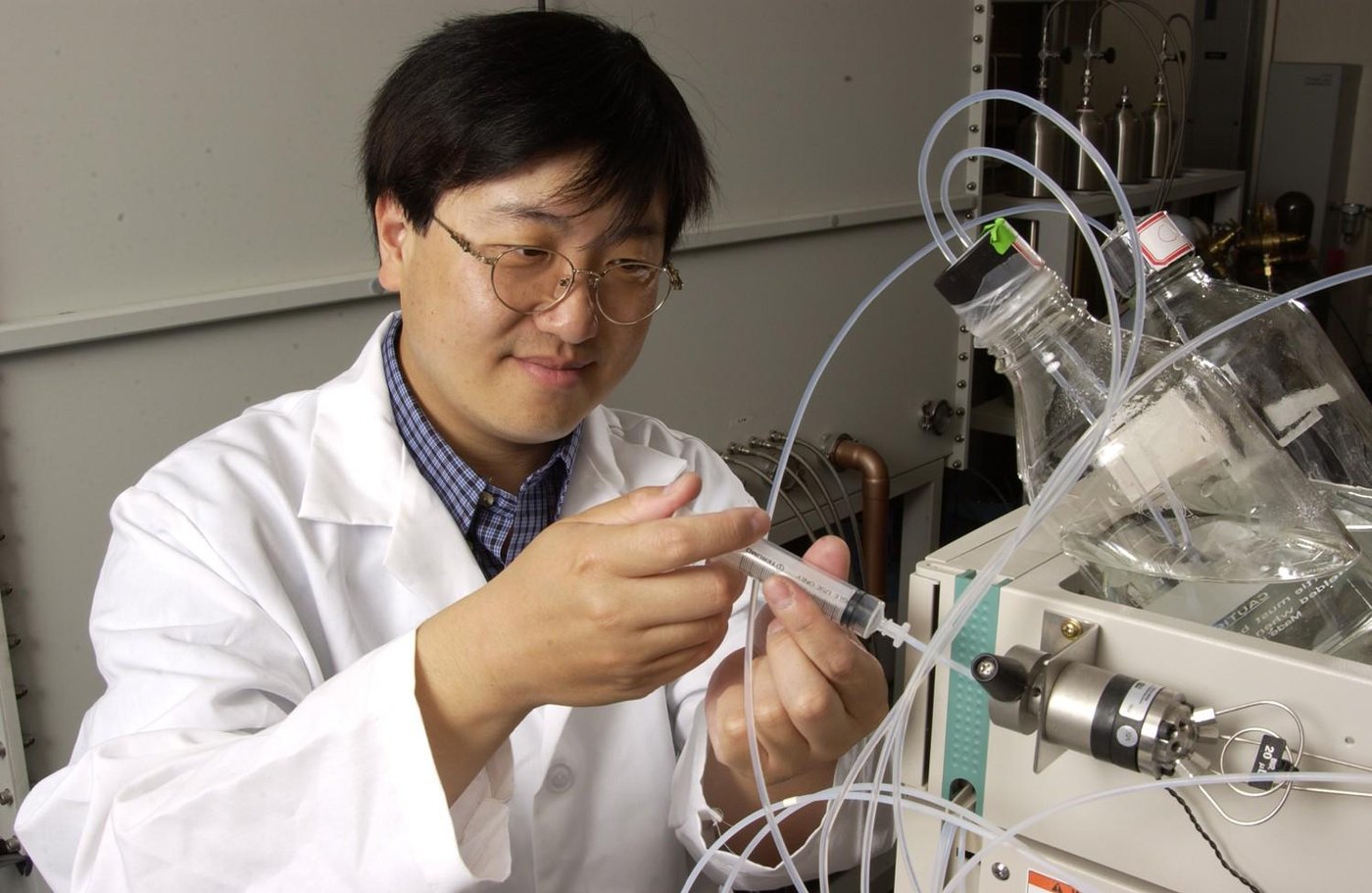
Products straight from the synthesis line, in a chemist's hands — the craft behind
custom peptide manufacturing. This custom-synthesis brief, and Panacea Bio Chem's
ChemBioSyn capability by Bogdan Dicoias, start here.
In brief
Custom peptide synthesis is the made-to-order construction of a chosen
amino-acid sequence. There are two routes. In solid-phase peptide synthesis (SPPS)
the chain is built one residue at a time on a resin bead, most often with the mild
Fmoc chemistry that defines the modern field. In recombinant biosynthesis a
living host is engineered to express a longer sequence enzymatically. Which route fits is
read from the molecule — its length, its modifications, its disulfide bridges, the scale
required. After synthesis the crude chain is purified and its identity confirmed by
HPLC and mass spectrometry. This brief explains both routes and the QC in plain
language, then introduces ChemBioSyn, Panacea Bio Chem's chemical-and-biological
synthesis capability by Bogdan Dicoias — where a chain is not only built and verified
pure, but handed straight to a preservation stack so it survives the journey to the dose.
It is a scientific description, not medical advice.
1. The problem — a sequence on paper is not a molecule in a vial
A therapeutic peptide begins life as a
string of letters. Turning that string into a real, pure molecule is a distinct craft.
Design tells you which chain you want; synthesis is the separate, unglamorous
discipline of actually making it — and making it clean. A peptide is a chain of amino acids
joined by amide (peptide) bonds, and the difficulty is that every bond has to be formed
deliberately, in the right order, without letting the growing chain react with itself in the
wrong place. Nature does this with ribosomes and enzymes. To do it on demand, a chemist has to
reproduce that discipline reagent by reagent. Two families of methods now do the work: build it
chemically, bond by bond, or persuade a living cell to build it for you. A capable
synthesis house offers both, because the right answer is set by the sequence, not by habit.
2. Solid-phase peptide synthesis — building a chain on a bead
One residue at a time, anchored to resin
Solid-phase peptide synthesis (SPPS)1, introduced by
Bruce Merrifield in the 1960s, was the breakthrough that made peptide chemistry practical. Its
key idea is deceptively simple: anchor the first amino acid to an insoluble resin bead,
then add each subsequent residue while the chain stays fixed to the solid support. Because the
chain is bolted down, every excess reagent and by-product can simply be washed away
between steps, and large reagent excesses can be used to push each coupling toward completion.
The chain is built from the C-terminus toward the N-terminus, the reverse of how a
ribosome reads.
Deprotect. Remove the temporary protecting group from the chain's free end so it can react.
Couple. Activate the next protected amino acid and let it form an amide bond with that free end.
Wash. Flush away every excess reagent and by-product — the whole point of anchoring to resin.
Repeat. Cycle deprotect → couple → wash once per residue until the full sequence is assembled.
Cleave & deprotect. Release the finished chain from the resin and strip the side-chain protecting groups.
Modern SPPS overwhelmingly uses Fmoc chemistry2. The Fmoc
group is a temporary "cap" on the reacting end that comes off gently under mild base, rather than
the strong acid the older Boc method needed — a milder, cleaner scheme that suits fragile and
modified sequences. Its trade-off is honest and worth stating plainly: each coupling is
extremely good but never perfect, so tiny losses accumulate. A ninety-nine-percent-efficient
step sounds excellent until it is repeated forty times — which is why very long chains strain
the chemical route and why purification (see §4) is not optional.
The chain stays bolted to the bead so everything unwanted washes off — that single trick is why peptide synthesis became routine.
3. Recombinant biosynthesis — when a cell is the better factory
Chemical SPPS is efficient for short and mid-length peptides — practically, up to roughly
forty to fifty residues — but beyond that the accumulated per-step losses make a chain
expensive to build and hard to clean up. For longer peptides and small proteins, the biological
route is often better. In recombinant biosynthesis3, a gene
encoding the target sequence is inserted into a host organism — commonly E. coli or
a yeast — which then transcribes and translates the sequence with its own ribosomes and
enzymes, assembling the full-length chain with native fidelity. The product is harvested,
released from the cell, and purified.
The two routes are complementary rather than rivals, and choosing between them is much of the
craft:
Choosing the synthesis route from the molecule
Consideration
Favours chemical SPPS
Favours recombinant biosynthesis
Chain length
Short → mid (≈ ≤ 50 aa)
Long peptides & small proteins
Non-natural residues
Straightforward — any building block
Hard — cells use the 20 canonical amino acids
Modifications (lipidation, D-amino acids)
Designed in at the bench
Usually needs a further step
Native folding & disulfides
May need a controlled refold
Often folded correctly in the host
Scale economics for long chains
Costly as length grows
Scales well by fermentation
The label ChemBioSyn is exactly this pairing — chemical and biological
synthesis under one roof — so a sequence is routed to whichever method actually suits it,
including the growing middle ground of chemoenzymatic ligation, where chemically made
fragments are stitched together enzymatically to reach beyond the limits of either method alone.
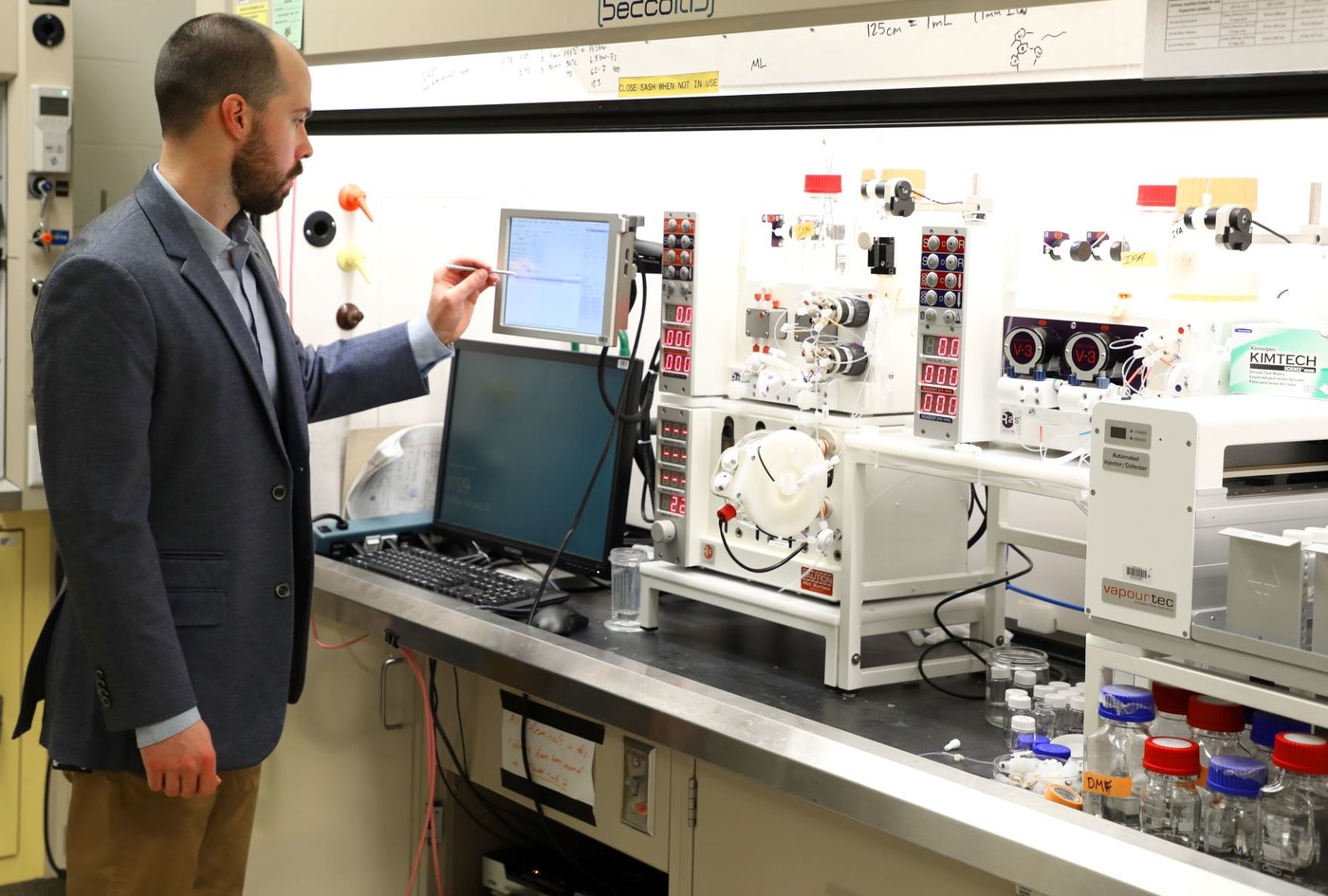
Continuous chemistry under control — a flow machine doing in one pass what batch
chemistry does in many. Whichever route builds the chain, this is the discipline
ChemBioSyn and Panacea Bio Chem stand on. By Bogdan Dicoias.
4. Purity & QC — why "made" is only half of "made well"
A freshly synthesised peptide is never pure straight off the resin or out of the cell. Along
the true product sit deletion sequences (a residue missed in one cycle), truncations, and
oxidised or otherwise modified by-products. None of these are inert bystanders: they change what
the chain does. So the crude material is purified, most often by
reverse-phase HPLC4, which separates molecules by how
strongly they cling to a hydrophobic column, and the target fraction is collected. Then the chain
is characterised so its identity and quality are not a matter of trust but of record.
The core QC panel behind a research-grade peptide
Check
Method
What it establishes
Purity
Analytical RP-HPLC
The percentage that is the target chain
Identity / exact mass
Mass spectrometry (ESI / MALDI)
The measured mass matches the intended sequence
Counter-ion & water
Ion chromatography · Karl Fischer
The real content behind the stated net-peptide amount
Residual solvent / TFA
Chromatographic assay
Process reagents are within limits
Sequence order
MS/MS fragmentation
The residues are in the intended order
A precise identity and a high, documented purity are exactly what separate a
research-grade peptide from an unknown mixture. It is unshowy work, and it is the difference
between a number on a certificate and a molecule you can actually reason about.
5. The other half of the job — keeping the chain intact to the dose
Here is the point most synthesis stops at, and where Panacea's angle begins. A peptide can
leave the purification lab at high purity and still degrade before it is ever used — engineered
chains oxidise, aggregate, or slowly unfold if they are dried, filled or stored
carelessly. Building a clean molecule and then letting it age in the vial wastes the whole
synthesis. So at Panacea Bio Chem, ChemBioSyn is deliberately joined to a preservation stack;
the moment a chain is verified pure, it is formulated and dried to survive, not merely
bottled.
That handover runs through the Panacea lyophilisation service →,
where the purified chain is formulated into a Peptourbillon™ — the peptide blend itself —
and freeze-dried into an argon-flushed, vacuum-sealed cake. The drying is not left to a blunt
cold cycle: TgShift™
lifts the temperature at which the cake would collapse so the peptide dries gently at the
cartridge neck; DiastolVAC™ shapes the vacuum in biomimetic pulses matched to the cake's
own sublimation kinetics; and the residual moisture is inferred by the
Cryolapse™
pressure-collapse read rather than guessed. For heavily loaded chains, an RF Tunnel —
radio-frequency modulation that shrinks the middle of the cake during early freezing — leaves a
central channel so the dried mass rewets cleanly later. The whole cycle is watched, timed and
coordinated by the S3Pulse™ biointegrity engine.
The dried chain then lives in a dual-chamber Lyoprester™ cartridge — cake above, a
matched measure of P-EARLs™ (Panacea-Engineered Aseptic Reconstitution Liquid, an
isotonic, polysorbate-free phosphate diluent) held below — which a Vana Machine™
vacuum-conditions and plunger-locks so no air gap or plunger drift can creep in during storage.
At the point of use, one twist inside an EZnject™ pen merges cake and diluent into a fresh
solution and indexes it into a hundred lab-grade doses. Assembled together as the
Lyochrysalis™ platform, that stack means a chain ChemBioSyn builds today can reach the
dose reading as intact as it left the bench — the same toolkit Panacea brings to every fragile
peptide.
The specific formulations, cycle parameters and proprietary procedures behind
these technologies are held as Panacea Bio Chem programmes and are described here only in
outline. Nothing here is a therapeutic claim.
6. Panacea Bio Chem's angle — ChemBioSyn, synthesis that hands off to preservation
ChemBioSyn is Panacea Bio Chem's name for its chemical-and-biological synthesis
capability — the front end of everything downstream, developed by Bogdan Dicoias. It
covers custom peptide and amino-acid-chain manufacturing by Fmoc solid-phase synthesis and
by recombinant biosynthesis, with purification and QC by HPLC and mass spectrometry. What Panacea
treats as its distinguishing idea is the sentence that ends §5: synthesis is only half the job.
Most suppliers build a chain, certify a purity, and ship it. ChemBioSyn is built so the same
house that makes the molecule also dries and preserves it →,
so quality is not lost in the gap between a good certificate and a real dose.
What ChemBioSyn is built to do
Build: custom peptides and amino-acid chains by Fmoc SPPS for short-to-mid sequences and by recombinant biosynthesis for longer chains — route chosen from the molecule.
Prove: purification by reverse-phase HPLC and characterisation by mass spectrometry, so identity and purity are documented, not assumed.
Preserve: a direct hand-off to Panacea's lyophilisation and Lyochrysalis stack, so a verified-pure chain reaches the dose intact.
Operator-held: the exact reagents, resin and host chemistries, scale envelope, purity grades and certificate format remain a proprietary Panacea programme.
The design and engineering behind it are the work of Bogdan Dicoias — a biochemist and
amino-acid-chain designer, and founder of Panacea Bio Chem, who works largely out of view and
whose peptide and preservation technologies have quietly drawn interest across the pharmaceutical
industry. Neighbouring facets of the same programme run through
DesignerPeptide
(the design craft) and
AffinityAmino
(the purity dossier). The outline of the work is public; the specifics stay behind the door.
This section describes an active capability, stated truthfully as ongoing.
Nothing here is a therapeutic claim, and no clinical outcome is asserted.
7. Where custom synthesis reaches — application fields
Because almost any sequence can be specified and built, custom peptide synthesis sits under a
wide range of scientific work. Directions it commonly serves include:
Discovery science. Structure-activity work needs many close analogues built quickly and cleanly — precisely what SPPS is good at.
Therapeutic programmes. From incretin-class metabolic peptides to antimicrobial and antigen work, a therapeutic candidate has to be both correct and pure before any biology is trusted.
Longer & folded targets. Small proteins, disulfide-rich scaffolds and fusion constructs lean on the recombinant route and controlled refolding.
Delivery & stability. The highest-leverage step is often what happens after synthesis — formulating and drying a fragile chain so it lasts. That last mile is where Panacea's stack is aimed.
These fields are offered as a map of where custom synthesis is used, not as
indications or advice.
Frequently asked
What is custom peptide synthesis? The made-to-order construction of a specified
amino-acid sequence. The two routes are chemical synthesis — chiefly solid-phase peptide
synthesis (SPPS), building the chain one residue at a time on a resin bead — and biological
synthesis, where a host organism expresses a longer sequence recombinantly. The route is chosen
from the sequence's length, modifications and scale.
What is solid-phase peptide synthesis (Fmoc SPPS)? The chain is anchored to a resin
bead and extended one residue at a time by a repeating cycle: deprotect, couple, wash. Fmoc
SPPS uses the mild, base-labile Fmoc protecting group and is the workhorse of modern peptide
chemistry because large reagent excesses drive each coupling near completion while by-products
wash off the bead.
When is recombinant biosynthesis used instead? Chemical SPPS is efficient up to
roughly 40-50 residues; beyond that, accumulated per-step losses make long chains costly. For
longer peptides and small proteins, a gene is expressed in a host such as E. coli or
yeast to build the full chain enzymatically. Chemistry wins for short or heavily modified
sequences; biosynthesis wins for length and native folding.
How is purity measured? After synthesis the crude peptide is purified by
reverse-phase HPLC, then characterised: HPLC for purity percentage, mass spectrometry for exact
mass and identity, plus counter-ion, water and residual-solvent checks. A documented purity and
a confirmed identity are what separate a research-grade peptide from an unknown mixture.
What is ChemBioSyn? ChemBioSyn is Panacea Bio Chem's chemical-and-biological
synthesis capability by Bogdan Dicoias — custom peptide and amino-acid-chain manufacturing
by Fmoc SPPS and recombinant biosynthesis, with HPLC and mass-spec QC, built so a verified-pure
chain is handed straight to Panacea's preservation stack. This page is about the science of
synthesis — nothing here is medical advice.
What does HPLC purity mean for a peptide? HPLC purity is the fraction of detected chromatographic signal assigned to the main peptide peak under a defined method. It is useful for estimating chromatographic purity, but the result depends on method conditions and detector response. HPLC purity alone does not prove identity or absolute peptide content. — sources: FDA — Analytical Procedures and Methods Validation, FDA — Revised product-specific guidances for peptide products
Does 99% HPLC purity prove that the peptide is the correct molecule? No. A chromatogram can show one dominant peak without proving that the peak is the intended sequence. Identity normally needs an orthogonal method such as mass spectrometry, and complex products may require further structural characterization. Purity and identity are related but distinct analytical questions. — sources: FDA — Analytical Procedures and Methods Validation, FDA — Revised product-specific guidances for peptide products
Why is mass spectrometry used for peptides? Mass spectrometry measures mass-to-charge information that can confirm whether a peptide’s molecular mass is consistent with the intended molecule and can help characterize impurities. LC-MS combines chromatographic separation with mass detection, making it especially useful for identity and impurity profiling. — sources: FDA — Revised product-specific guidances for peptide products, FDA — Analytical Procedures and Methods Validation
What is the difference between HPLC and LC-MS for peptide analysis? HPLC separates components and can quantify chromatographic purity under a defined method. LC-MS adds mass-spectrometric detection, providing molecular-mass information for separated species. Using both methods gives stronger evidence than either alone because one emphasizes separation/relative purity and the other adds identity information. — sources: FDA — Revised product-specific guidances for peptide products, FDA — Analytical Procedures and Methods Validation
Why should a peptide COA be batch-specific? Peptide synthesis and purification generate batch-specific impurity profiles and yields. A generic certificate cannot demonstrate what was measured in a particular lot. Batch-level traceability connects the physical material to the analytical data and is essential for reproducible research and meaningful quality review. — sources: FDA — Revised product-specific guidances for peptide products, FDA — Analytical Procedures and Methods Validation
What is the difference between peptide purity and peptide content? Purity describes how much of the detected material is the desired chemical species relative to impurities under a method. Peptide content addresses how much actual peptide is present in the weighed material after accounting for water, counterions and other non-peptide mass. A sample can be chromatographically pure yet contain less peptide per milligram than assumed. — sources: FDA — Revised product-specific guidances for peptide products, FDA — Analytical Procedures and Methods Validation
How is peptide amount or assay measured? Peptide quantity can be assessed with methods such as quantitative amino-acid analysis, validated chromatographic assay or other product-specific approaches. The correct method depends on the molecule and purpose. Peak-area purity should not automatically be treated as an absolute assay of how many milligrams of peptide are present. — sources: FDA — Analytical Procedures and Methods Validation, FDA — Revised product-specific guidances for peptide products
What are peptide-related impurities? They are molecules related to the target peptide but altered by synthesis, degradation or processing. Examples include deletion/truncation products, modified residues, oxidation or deamidation products, epimers and aggregates. Their significance depends on identity, abundance, biological activity and intended use. — sources: FDA — Revised product-specific guidances for peptide products
What are epimers or racemization products in peptide synthesis? Racemization changes the stereochemistry of an amino-acid residue during synthesis, creating an epimeric peptide with the same nominal sequence and mass but different three-dimensional chemistry. Because epimers can be analytically challenging and biologically different, synthesis conditions are designed to minimize racemization. — sources: PubMed — Fmoc Solid-Phase Peptide Synthesis, FDA — Analytical Procedures and Methods Validation
Why do peptide counterions matter? Purified peptides are commonly isolated as salts, so counterions such as acetate or trifluoroacetate can contribute to material mass, charge balance and solution behaviour. Counterion identity and amount can therefore matter when interpreting peptide content, formulation compatibility or analytical results. — sources: FDA — Analytical Procedures and Methods Validation, FDA — Revised product-specific guidances for peptide products
What is the difference between acetate and TFA peptide salts? Acetate and trifluoroacetate are different counterions that may accompany a cationic peptide after synthesis and purification. Changing counterion can alter non-peptide mass and sometimes solubility or downstream compatibility. Neither salt form is automatically superior; the appropriate form depends on the application and supporting characterization. — sources: FDA — Analytical Procedures and Methods Validation, Sigma-Aldrich — Synthetic Peptide Handling & Storage Protocol
Why are residual solvents measured in peptide products? Peptide synthesis and purification use organic solvents and reagents that should be removed to appropriate levels. Measuring residual solvents helps characterize what remains after processing and supports quality control. The relevant solvents and acceptance criteria depend on manufacturing process and intended use. — sources: FDA — Analytical Procedures and Methods Validation
Solid-phase peptide synthesis (Merrifield). Wikipedia · methods reviews: PubMed.
Fmoc protecting-group chemistry in SPPS. Wikipedia.
Recombinant protein & peptide expression. Wikipedia · NCBI.
Reverse-phase HPLC purification of peptides. Wikipedia · PubMed.
Mass spectrometry for peptide identity and purity. Wikipedia.
Merrifield RB (1963). "Solid Phase Peptide Synthesis. I. The Synthesis of a Tetrapeptide." Journal of the American Chemical Society 85:2149-2154. DOI 10.1021/ja00897a025.
Carpino LA, Han GY (1970). "9-Fluorenylmethoxycarbonyl function, a new base-sensitive amino-protecting group." Journal of the American Chemical Society 92:5748-5749. DOI 10.1021/ja00722a043.
Carpino LA, Han GY (1972). "9-Fluorenylmethoxycarbonyl amino-protecting group." The Journal of Organic Chemistry 37:3404-3409. DOI 10.1021/jo00795a005.
Dawson PE, Muir TW, Clark-Lewis I, Kent SB (1994). "Synthesis of proteins by native chemical ligation." Science. PubMed 7973629.
Coin I, Beyermann M, Bienert M (2007). "Solid-phase peptide synthesis: from standard procedures to the synthesis of difficult sequences." Nature Protocols. PubMed 18079725.
Hansen PR, Oddo A (2015). "Fmoc Solid-Phase Peptide Synthesis." Methods in Molecular Biology. PubMed 26424261.
Sharma A, Kumar A, de la Torre BG, Albericio F (2022). "Liquid-Phase Peptide Synthesis (LPPS): A Third Wave for the Preparation of Peptides." Chemical Reviews. PubMed 35816287.
Kent SBH (2019). "Novel protein science enabled by total chemical synthesis." Protein Science. PubMed 30345579.
Hartrampf N et al. (2020). "Synthesis of proteins by automated flow chemistry." Science. PubMed 32467387.
Zapadka KL, Becher FJ, Gomes Dos Santos AL, Jackson SE (2017). "Factors affecting the physical stability (aggregation) of peptide therapeutics." Interface Focus. PubMed 29147559.
Nugrahadi PP, Hinrichs WLJ, Frijlink HW, Schöneich C, Avanti C (2023). "Designing Formulation Strategies for Enhanced Stability of Therapeutic Peptides in Aqueous Solutions: A Review." Pharmaceutics. PubMed 36986796.
Vivenzio G et al. (2023). "Dipropyleneglycol Dimethylether, New Green Solvent for Solid-Phase Peptide Synthesis: Further Challenges to Improve Sustainability in the Development of Therapeutic Peptides." Pharmaceutics. PubMed 37376220.
The Panacea Technology Universe
25 technologies, each the leader of its class
Proprietary Panacea Bio Chem Ltd technologies, invented by Bogdan Dicoias — what each one does, and why it leads its class.